How to Select Safe Switches and Sockets for Your Home
A practical checklist for ratings, materials, earthing, installation and everyday use.
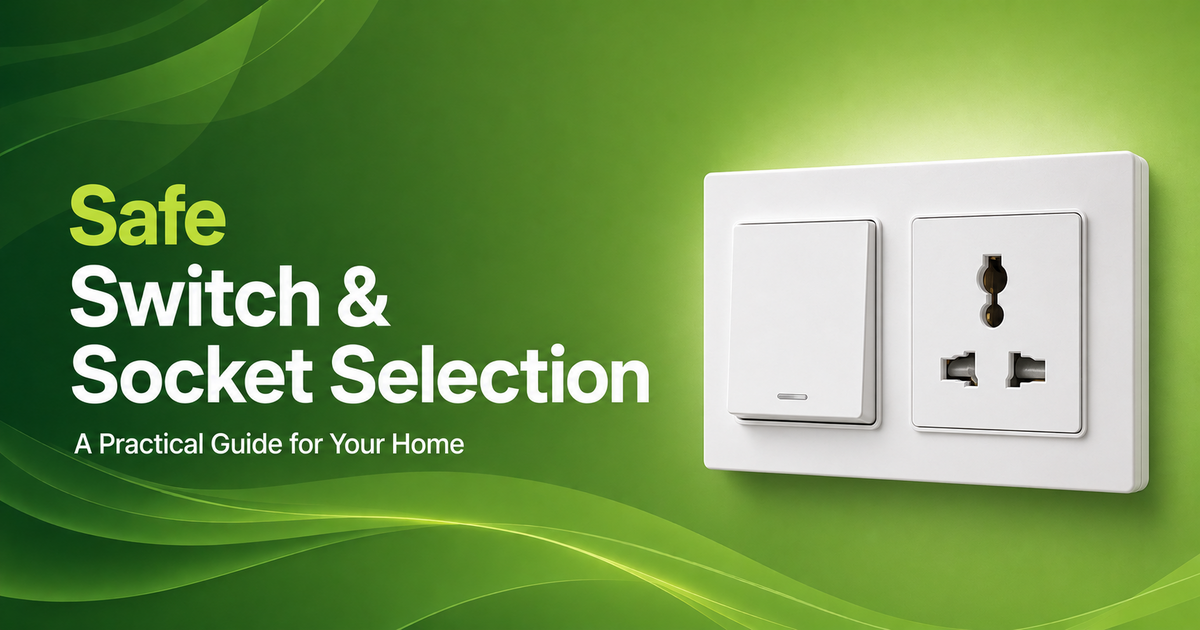
Why switch and socket selection matters#
Switches and sockets are touched and used every day, yet they carry mains electricity behind the faceplate. A poor-quality device, incorrect rating, loose connection or unsuitable installation can lead to overheating, electric shock, damaged appliances or fire.
Appearance is important, but safety must come first. Select the device for its electrical duty, construction, installation environment and compatibility with the complete circuit.
Quick safety checklist#
Before buying, check:
- Rated voltage and current
- Intended application and load
- Socket and plug compatibility
- Earthing provision where required
- Shutter protection
- Terminal and contact quality
- Faceplate and internal material quality
- Mounting box and wiring space
- Suitability for damp or outdoor areas
- Clear product identification and warranty
- Professional installation
A switch or socket should never be selected only because its faceplate looks attractive.
1. Check the voltage and current rating#
The device rating must suit the electrical supply and the load it will control.
A current rating such as 6A, 10A, 13A, 16A or 20A states the maximum current under specified conditions. It does not mean every appliance can be safely connected. The plug, cable, circuit breaker, socket, wiring and installation method must all be coordinated.
High-power appliances may require:
- A correctly rated dedicated socket
- A suitable double-pole switch or isolator
- An appropriately sized cable
- A correctly selected protective device
- A dedicated circuit
Never replace a lower-rated device with a higher-rated one without checking the cable and circuit design.
2. Match the socket to the plug and appliance#
Use a socket designed for the plug type and electrical load. Avoid forcing a plug into an incompatible outlet or using loose universal adaptors.
For frequently used appliances, choose an outlet that provides firm contact and is installed at a practical height and position. High-power appliances should not depend on stacked adaptors or overloaded extension boards.
3. Look for shutter protection#
A shuttered socket uses an internal barrier to reduce accidental access to live contacts when no correct plug is inserted.
Shutters are particularly valuable in homes with children, schools and public spaces. They are an added protective feature, not a substitute for supervision, proper earthing or residual-current protection.
Do not insert objects into a socket to test the shutter mechanism.
4. Check earthing provisions#
Appliances that require protective earthing must be connected through a correctly earthed socket and circuit. The earth contact, conductor and building earthing system must all be continuous and correctly installed.
A three-pin socket does not prove that the earth connection is working. Only appropriate inspection and testing can confirm earthing integrity.
Never remove the earth pin from a plug or use an adaptor that defeats the earth connection.
5. Review contact and terminal quality#
Inside a switch or socket, current flows through metal contacts and terminals. Poor contact pressure or loose terminals create resistance, which produces heat.
Look for:
- Firm plug retention
- Smooth switch operation
- Clearly marked terminals
- Adequate terminal space
- Secure conductor clamping
- Suitable contact materials
- No visible cracks, distortion or loose parts
A plug that falls out easily, a switch that feels irregular or a socket that becomes warm should be investigated.
6. Choose durable faceplate and internal materials#
The faceplate should resist normal impact, wear, heat and discolouration. The internal mechanism should maintain alignment and contact pressure over repeated use.
Published product pages may list polycarbonate, tempered glass or other materials. Each material has different aesthetic and mechanical characteristics, but the full safety performance depends on the complete device—not the faceplate alone.
Do not paint over a switch or socket, and keep dust, moisture and construction debris away from the mechanism.
7. Consider the installation environment#
Bedrooms and living areas#
Standard indoor switches and sockets may be suitable when installed away from moisture and heat.
Kitchens#
Place outlets away from sinks, flames and hot surfaces. High-load cooking appliances may need dedicated circuits and isolators.
Bathrooms and wet areas#
These locations require special zoning, protection and appropriately rated equipment. Use professional design and installation.
Outdoor areas#
Use products specifically rated for outdoor exposure, with suitable ingress protection, enclosure, glands and seals.
Commercial and public spaces#
Consider higher usage frequency, impact resistance, cleaning methods, accessibility and maintenance requirements.
8. Check the back box and installation depth#
A good front device can still fail when forced into an unsuitable box.
The mounting box should provide:
- Enough depth for the mechanism and conductors
- Secure fixing points
- Correct alignment
- No sharp edges that damage insulation
- Adequate space without crushing or sharply bending wires
Loose faceplates, overcrowded boxes and damaged cable insulation must be corrected.
9. Buy identifiable products from reliable sources#
Check the brand name, product code, rating markings, packaging, warranty information and seller.
Avoid devices with:
- Missing or inconsistent markings
- Poor moulding or rough edges
- Loose terminals
- Unclear origin
- No product information
- Unusually low pricing without traceable support
Use an authorized distributor or reliable retailer so the product can be identified and supported.
10. Use qualified installation and testing#
Mains wiring should be installed and tested by a qualified electrician. Correct work includes isolating the supply, identifying conductors, tightening terminals correctly, testing polarity and earthing, and confirming that protective devices operate as intended.
Do not rely only on whether the switch turns a light on or the socket powers an appliance. A circuit can appear to work while still being unsafe.
Warning signs after installation#
Stop using the device and arrange inspection if you notice:
- Heat at the faceplate or plug
- Burning smell
- Buzzing or crackling
- Brown marks or melting
- Sparking
- Loose plug contact
- Repeated breaker operation
- Electric shock or tingling
- A switch that feels rough or sticks
- A faceplate that moves when used
Switch off the relevant circuit if it is safe to do so. Do not keep using the outlet while waiting for repair.
AKIJ switch and socket options#
AKIJ Electricals offers multiple switch and socket series for residential and commercial applications. Published product pages provide model-specific details such as colour, material, maximum voltage, maximum current, dimensions and operating-cycle information where available.
Explore AKIJ Switch & Socket products
For example, published AKIJ Divine grey-series switch pages specify a tempered-glass and polycarbonate construction, a maximum operating voltage of 250V AC and model-specific current and operating-cycle information. Always confirm the specifications of the exact model being purchased.
Product note: A device rating must be matched with the cable, protection, load and installation. Product selection and wiring should be verified by a qualified electrical professional.
Common mistakes to avoid#
- Choosing only by colour or design
- Using a 13A label as permission to connect any appliance
- Forcing incompatible plugs into universal sockets
- Removing earth pins
- Overloading extension boards
- Using indoor products outdoors
- Ignoring heat, smell or discolouration
- Installing into an overcrowded or damaged back box
- Mixing unmatched modular components
- Performing live electrical work
Conclusion#
Safe switch and socket selection is a system decision. Check the rating, load, plug type, earthing, shutters, contacts, materials, environment, back box and protective device together.
Choose traceable products, use professional installation and act quickly when there is heat, smell, noise, looseness or sparking.
Frequently asked questions
- Is a 13A socket suitable for every appliance?
- No. The socket rating is only one part of the circuit. The plug, cable, protective device, wiring method and appliance load must all be suitable and professionally coordinated.
- What is a shuttered socket?
- A shuttered socket has an internal barrier that helps prevent access to live contacts when no correct plug is inserted. It adds protection but does not replace supervision or safe use.
- Can a loose socket be repaired without switching off power?
- No. Stop using it, isolate the circuit and ask a qualified electrician to inspect the socket, back box, terminals and wiring. Loose connections can overheat and become a fire risk.
- Should I use an adaptor for a high-power appliance?
- Use only an adaptor specifically rated and approved for the appliance and circuit. High-power appliances are often safer on a correctly installed dedicated outlet without stacked adaptors or extension leads.