How to Select the Correct MCB Rating Safely
Understand load current, cable capacity, breaking capacity, trip curve and pole selection.
Why MCB selection requires more than an ampere number#
An MCB, or Miniature Circuit Breaker, protects cables and circuits against overload and short circuit. The number printed on the front—such as 6A, 10A, 16A, 20A, 32A or 40A—is its rated current, but this is only one part of correct selection.
A breaker that is too small may trip during normal operation. A breaker that is too large may allow the cable to overheat before the breaker responds.
The correct MCB must be coordinated with:
- The expected load current
- The cable's current-carrying capacity
- The cable material and cross-sectional area
- Installation method and ambient conditions
- Starting or inrush current
- Prospective short-circuit current
- Trip characteristic
- Number of poles
- Supply and earthing arrangement
- Other protective devices
- Applicable electrical requirements
The core safety relationship#
A useful design principle is:
Design current ≤ MCB rated current ≤ cable current-carrying capacity
In symbols, this is often written as:
Ib ≤ In ≤ Iz
Where:
- Ib is the design current of the circuit
- In is the rated current of the protective device
- Iz is the cable's allowable current after applying relevant correction factors
This relationship is only part of the full design. Disconnection time, fault-loop conditions, breaking capacity, thermal effects and device coordination must also be verified.
Step 1: Calculate or determine the design current#
For a simple single-phase resistive load, current can be estimated using:
Current (A) = Power (W) ÷ Voltage (V)
For example, a 2,300W resistive load at 230V draws approximately 10A.
This simple calculation is not sufficient for every load. Motors, air conditioners, pumps, refrigerators, transformers, LED drivers and other electronic equipment may have:
- Power factor
- Efficiency losses
- Starting current
- Inrush current
- Variable operating demand
- Harmonics
- Manufacturer-specified protection
Use the equipment nameplate and technical instructions. For multiple loads, consider diversity and simultaneous operation according to the project design and applicable rules.
Step 2: Check the cable capacity#
The MCB protects the cable, so the breaker rating must not exceed the cable's allowable current under the actual installation conditions.
Cable current capacity depends on:
- Copper or aluminium conductor
- Conductor cross-sectional area
- Insulation type and temperature rating
- Installation in conduit, trunking, wall, air or ground
- Number of loaded conductors
- Ambient temperature
- Grouping with other circuits
- Thermal insulation
- Cable length and voltage drop
- Terminal temperature limits
Do not select a cable or MCB from a simplified internet chart without confirming that the chart matches the cable type and installation method.
Step 3: Apply correction or derating factors#
A cable can carry less current when it is installed in a hot location, grouped with other loaded cables, surrounded by thermal insulation or used under other unfavourable conditions.
The adjusted cable capacity—not the ideal catalogue value—must be used when checking the breaker rating.
This is why the same cable size does not always use the same MCB in every building.
Step 4: Select the rated current#
Choose a standard MCB rating that can carry the intended design current while still protecting the adjusted cable capacity.
Do not automatically round upward. If the next standard rating is above the cable capacity, the options may include:
- Reducing the load
- Dividing the load across more circuits
- Increasing the cable size
- Changing the installation method
- Selecting different equipment
- Redesigning the circuit
The correct choice must be verified by a qualified electrical professional.
Step 5: Check the trip curve#
The trip characteristic describes how the MCB responds to different levels of overcurrent, especially short-duration starting currents.
Common curves include B, C and D, but availability and application vary.
- B curve: Often associated with circuits having relatively low inrush current
- C curve: Common for general circuits and loads with moderate inrush
- D curve: Used for some high-inrush applications where the complete system has been designed accordingly
A curve should not be selected merely to prevent nuisance tripping. The fault current must be high enough for the breaker to operate within the required time, and the load's starting behaviour must be understood.
Step 6: Verify breaking capacity#
Breaking capacity is the maximum prospective short-circuit current the breaker can safely interrupt under specified conditions.
The available fault current depends on the transformer, supply network, conductor impedance and installation position. A breaker installed near a large transformer may face a much higher short-circuit current than one at the end of a long final circuit.
Never assume that current rating and breaking capacity are the same. A 16A breaker must still have adequate breaking capacity for the location.
Step 7: Select the number of poles#
Single pole (1P)#
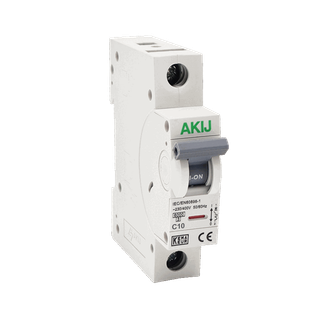
Commonly used to protect and disconnect the phase conductor of an individual single-phase outgoing circuit where the system design permits.
Double pole (2P)#
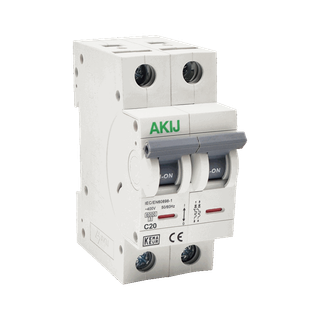
Can disconnect phase and neutral together in single-phase installations where double-pole isolation is required by the design.
Triple pole (3P)#
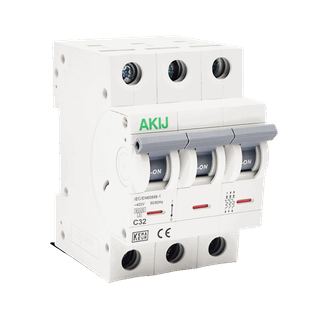
Used for three-phase circuits where all three phase conductors must operate together.
Other arrangements, including four-pole and 1P+N devices, exist. Pole selection depends on the supply, neutral treatment, earthing arrangement and isolation requirements.
Step 8: Check voltage, frequency and standards#
Verify that the breaker is suitable for the system voltage, frequency and application.
IEC 60898-1 covers circuit breakers for overcurrent protection in household and similar AC installations within its specified scope. Other applications may require devices under different standards.
View the IEC 60898-1 public overview
Product markings and technical documentation should be checked for the exact model.
Step 9: Coordinate with residual-current protection#
An MCB does not normally detect the small leakage currents associated with many electric-shock risks. Depending on the installation, an RCCB or RCBO may also be required.
An RCCB provides residual-current protection but normally needs separate overcurrent protection. An RCBO combines residual-current and overcurrent functions.
For a broader comparison, read MCB vs MCCB vs RCCB: What Is the Difference?
Step 10: Consider selectivity and upstream protection#
In a building with multiple breakers, a downstream fault should ideally disconnect the smallest necessary part of the system. Coordination between upstream and downstream devices helps limit unnecessary outages.
This requires manufacturer data, time-current characteristics and fault-level calculations. It is especially important in commercial and industrial distribution systems.
AKIJ MCB options#
AKIJ Electricals currently publishes MCB options across single-pole, double-pole and triple-pole configurations, with current ratings from 6A to 63A depending on the pole option.
Published range features include:
- Type-C tripping characteristic
- Thermal-magnetic protection
- DIN-rail mounting
- Overload and short-circuit protection
- 3-year warranty support
Browse the current AKIJ MCB range
Choose a model only after confirming the design current, cable capacity, breaking capacity, pole arrangement and system conditions.
Safety notice: The MCB rating should be selected or verified by a qualified electrical professional. Do not increase a breaker rating simply because it trips frequently.
Common mistakes to avoid#
- Choosing from appliance wattage alone
- Selecting the MCB before selecting and derating the cable
- Ignoring motor or compressor starting current
- Fitting a larger breaker to stop nuisance tripping
- Ignoring breaking capacity
- Using the wrong trip curve
- Confusing pole count with current rating
- Assuming an MCB provides residual-current protection
- Mixing incompatible devices in a distribution board
- Repeatedly resetting a breaker without finding the fault
- Working on an energized distribution board
Conclusion#
Correct MCB selection balances normal operation with cable and fault protection.
Start with the load current, verify the derated cable capacity, choose an appropriate standard rating, check the trip curve and breaking capacity, select the correct poles, and coordinate the device with residual-current and upstream protection.
Because these factors depend on the actual installation, final selection and testing should be performed by a qualified electrical professional.
Frequently asked questions
- Can I choose an MCB only from appliance wattage?
- No. Wattage can help estimate load current, but the cable capacity, installation method, ambient temperature, grouping, starting current, fault level and protection requirements must also be checked.
- Can I stop frequent tripping by installing a higher-rated MCB?
- Not without a professional assessment. A larger breaker may fail to protect the existing cable. Identify the overload, fault, connection or equipment problem first.
- What is MCB breaking capacity?
- Breaking capacity is the maximum prospective short-circuit current the breaker is designed to interrupt under specified conditions. It must be adequate for the fault level at the installation point.
- Does an MCB protect against electric shock?
- An MCB primarily protects against overload and short circuit. Residual-current protection such as an RCCB or RCBO may also be required for electric-shock and leakage-current risks.