MCB vs MCCB vs RCCB: What Is the Difference and Which One Do You Need?
A practical guide to overload, short-circuit and leakage-current protection—and how to choose the right device.
MCB vs MCCB vs RCCB: What Is the Difference and Which One Do You Need?#
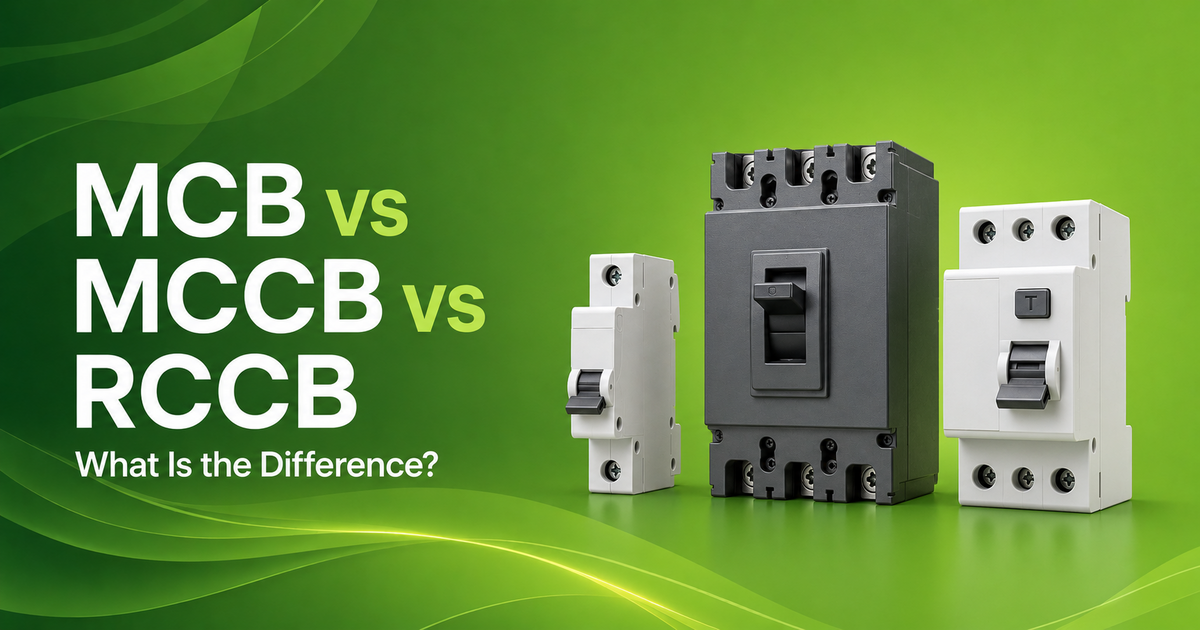
MCBs, MCCBs and RCCBs are important electrical protection devices, but they are designed for different purposes. Although they may all disconnect electricity when a fault occurs, they do not detect the same types of electrical problems.
An MCB protects a circuit against overload and short circuit. An MCCB performs a similar function but is generally used in higher-capacity commercial and industrial installations. An RCCB detects current leakage and provides additional protection against electric shock and certain earth-fault risks.
Understanding these differences is essential when planning a safe electrical distribution system.
Quick answer#
- MCB: Protects cables and circuits against overload and short circuit.
- MCCB: Provides overload and short-circuit protection for higher-capacity electrical systems.
- RCCB: Detects residual or leakage current and helps protect people against electric shock.
- RCBO: Combines overcurrent and residual-current protection in one device.
In many installations, an MCB or MCCB must work together with an RCCB because no single one of these devices provides every type of protection.
What is an MCB?#
MCB stands for Miniature Circuit Breaker. It is commonly used in homes, offices, shops and other relatively low-current electrical installations.
The main purpose of an MCB is to protect electrical cables and circuits from:
- Overload
- Short circuit
- Excessive current that could overheat wiring
An overload occurs when the connected appliances draw more current than the circuit and cable are designed to carry. A short circuit occurs when conductors at different electrical potentials come into unintended direct contact, causing a sudden and potentially dangerous rise in current.
An MCB automatically disconnects the circuit when it detects such conditions. Once the fault has been identified and corrected, it can normally be reset.
Where are MCBs commonly used?#
MCBs are frequently used to protect individual circuits such as:
- Lighting circuits
- Socket-outlet circuits
- Air-conditioner circuits
- Water-heater circuits
- Kitchen appliance circuits
- Small office and retail circuits
The MCB rating must be selected according to the cable capacity, connected load, installation method, expected fault current and applicable electrical requirements. An MCB does not necessarily trip immediately when current rises slightly above its marked rating; its response depends on the level and duration of the overcurrent and its tripping characteristic.
What is an MCCB?#
MCCB stands for Moulded Case Circuit Breaker. Like an MCB, it protects an electrical system against overload and short circuit. However, MCCBs are generally designed for higher-current applications and higher prospective fault levels.
Depending on the model, an MCCB may also provide adjustable protection settings. This allows qualified engineers to coordinate the breaker with cables, connected equipment and other protective devices.
Where are MCCBs commonly used?#
MCCBs are typically found in:
- Commercial buildings
- Factories and manufacturing plants
- Main distribution panels
- Large air-conditioning systems
- Motor-control applications
- Generators and transformer-fed systems
- Main incomers and distribution feeders
An MCCB may be used as the main protective device in a distribution panel, while MCBs protect the smaller outgoing circuits.
Not every MCCB has the same features or adjustable settings. Selection should therefore be based on the product’s technical specifications and a proper electrical-system study.
What is an RCCB?#
RCCB stands for Residual Current Circuit Breaker. Its primary function is to detect leakage or residual current.
Under normal conditions, the current flowing through the live conductor should return through the neutral conductor. If some current escapes through damaged insulation, an appliance body, an earth conductor or another unintended path, the incoming and returning currents become unbalanced.
An RCCB monitors this difference. When the residual current reaches its designed operating threshold, the RCCB disconnects the supply.
This provides additional protection against:
- Electric shock
- Current leakage to earth
- Insulation-related faults
- Some electrical fire risks caused by leakage current
Important limitation of an RCCB#
A standard RCCB does not provide built-in protection against overload or short circuit. It must be coordinated with an MCB, MCCB or another suitable overcurrent-protection device.
An RCCB should never be treated as a replacement for an MCB.
MCB vs MCCB vs RCCB: key differences#
| Feature | MCB | MCCB | RCCB |
|---|---|---|---|
| Full form | Miniature Circuit Breaker | Moulded Case Circuit Breaker | Residual Current Circuit Breaker |
| Main function | Overload and short-circuit protection | Higher-capacity overload and short-circuit protection | Residual-current or earth-leakage protection |
| Primary protection | Cables and electrical circuits | Feeders, cables and higher-capacity systems | People and installations exposed to leakage-current risks |
| Typical application | Homes, offices and individual final circuits | Commercial, industrial and main distribution systems | Residential, commercial and other installations requiring residual-current protection |
| Overload protection | Yes | Yes | No |
| Short-circuit protection | Yes | Yes | No |
| Leakage-current protection | No | Not unless specifically equipped | Yes |
| Adjustable settings | Usually fixed | Available on many models | Residual-current threshold is product-specific |
| Typical installation position | Outgoing or final circuit | Main incomer or distribution feeder | Upstream of one or more protected circuits or assigned to individual circuits |
Do you need both an MCB and an RCCB?#
In many electrical installations, the answer is yes.
An MCB and an RCCB monitor different fault conditions:
- The MCB responds to overload and short-circuit current.
- The RCCB responds to an imbalance caused by leakage current.
An MCB may not detect a relatively small leakage current passing through an unintended path. Similarly, an RCCB may remain connected during an overload if the outgoing and returning currents remain balanced.
Therefore, using only one of these devices may leave an important area of protection uncovered.
A properly designed distribution board may use an RCCB to provide residual-current protection for a group of circuits, with separate MCBs protecting each outgoing circuit. Another option is to use individual RCBOs.
What is an RCBO?#
RCBO stands for Residual Current Circuit Breaker with Overcurrent Protection.
It combines the principal functions of an MCB and an RCCB in one device. An RCBO can provide protection against:
- Overload
- Short circuit
- Residual or leakage current
RCBOs can be useful when individual residual-current protection is required for separate circuits. If one circuit develops a leakage fault, only the affected circuit may be disconnected, depending on the overall system design.
However, an RCBO must still be selected according to the circuit rating, cable capacity, residual-current requirement, breaking capacity and applicable standards.
Where does an MCCB fit into the system?#
An MCCB is often used further upstream in a larger distribution system.
For example, a commercial building might have:
- An MCCB protecting the main incoming supply or a major feeder.
- RCCBs or RCBOs providing residual-current protection where required.
- MCBs protecting individual lighting, socket and appliance circuits.
The exact arrangement depends on the building type, earthing system, connected load, fault level and required protection coordination.
A home will not normally require an MCCB for every circuit. Larger commercial and industrial installations, however, may require MCCBs because of their higher current and breaking-capacity requirements.
AKIJ MCB options for different circuits#
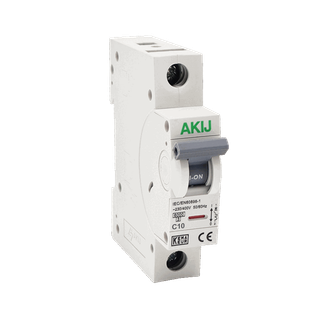
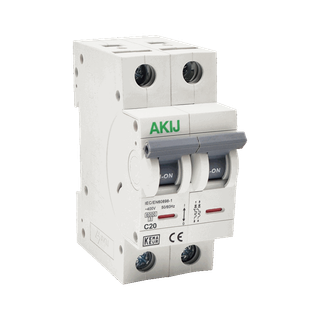
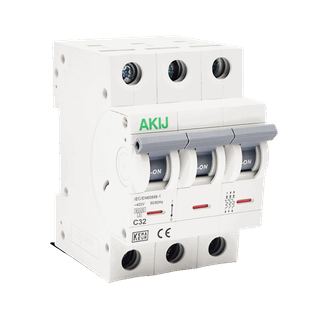
AKIJ Electricals currently offers 24 published MCB options for residential, commercial and distribution-board applications. The range includes single-pole, double-pole and triple-pole configurations, with current ratings from 6A to 63A depending on the pole configuration.
Key features across the published AKIJ MCB range include:
- Type-C tripping characteristic
- Thermal-magnetic overload and short-circuit protection
- DIN-rail mounting
- Single-, double- and triple-pole options
- 3-year warranty support
Choosing an AKIJ MCB configuration#
- Single pole (1P): Commonly used for individual single-phase outgoing circuits such as lighting and socket circuits.
- Double pole (2P): Disconnects both live and neutral conductors together where the installation design requires it.
- Triple pole (3P): Intended for three-phase circuits and equipment where three-pole isolation and protection are required.
Browse the current AKIJ MCB range
Selection notice: The correct breaker rating must be selected according to the connected load, cable capacity, installation method, prospective fault current and applicable electrical requirements. Always consult a qualified electrical professional.
How to select the correct protection device#
Selecting a circuit breaker involves more than choosing an ampere rating. A qualified electrical professional should consider:
1. Connected load#
The expected operating current of the circuit must be calculated.
2. Cable size and installation method#
The protective device must prevent the cable from carrying unsafe current. Cable material, cross-sectional area, ambient temperature, grouping and installation method can affect current-carrying capacity.
3. Breaking capacity#
The breaker must be capable of safely interrupting the prospective short-circuit current at its installation point.
4. Trip characteristic#
The operating characteristics should suit the connected load, particularly where motors, transformers or equipment with high starting current are involved.
5. Residual-current sensitivity#
For RCCBs and RCBOs, the residual operating current must be selected according to the required protection and applicable regulations. High-sensitivity devices rated at up to 30 mA are commonly associated with additional protection against electric shock, but the complete design must be verified professionally.
6. Number of poles#
The required pole configuration depends on whether the circuit is single-phase or three-phase and how neutral isolation is arranged.
7. RCCB type#
Different RCCB types respond to different residual-current waveforms. The appropriate type should be selected according to the connected equipment and electrical-system design.
8. Applicable standards#
Choose protection devices manufactured and tested according to relevant standards and verify the technical information provided by the manufacturer.
Common mistakes to avoid#
- Selecting an MCB only according to appliance wattage
- Installing a larger breaker without checking cable capacity
- Assuming an RCCB also protects against overload
- Using an MCB as the only protection against electric shock
- Ignoring the required short-circuit breaking capacity
- Repeatedly resetting a breaker without identifying the fault
- Bypassing a breaker because it trips frequently
- Mixing incompatible protection devices without checking coordination
- Performing distribution-board work without professional training
Frequent tripping is a warning that should be investigated. The breaker should not be replaced with a higher rating simply to stop the tripping.
Frequently asked questions#
Can an MCB protect someone from electric shock?#
An MCB is designed primarily to detect overload and short circuit. It should not be relied upon to detect the small residual currents associated with many electric-shock situations. Appropriate RCCB or RCBO protection may also be required.
Can an RCCB protect a circuit against short circuit?#
A standard RCCB does not include overload or short-circuit protection. It must be used with a suitable MCB, MCCB or fuse.
Is an MCCB better than an MCB?#
An MCCB is not automatically “better.” It is intended for different applications, particularly where higher current, higher fault capacity or adjustable protection is required. An MCB is normally more suitable for individual household and small commercial circuits.
Is an RCBO better than separate MCB and RCCB devices?#
Both arrangements can provide effective protection when correctly designed. RCBOs offer individual-circuit protection and can improve fault isolation, while grouped RCCB-and-MCB arrangements may be suitable for other distribution-board designs.
Should an RCCB be tested?#
RCCBs normally have a test button for checking their operating mechanism. Testing should be performed at the interval and in the manner stated by the product manufacturer. If the device does not trip during the prescribed test, contact a qualified electrician.
Which device is suitable for a home?#
A residential installation commonly uses MCBs together with RCCB protection or individual RCBOs. The correct arrangement depends on the circuits, earthing system and applicable electrical requirements. A qualified electrician should inspect the installation and determine the appropriate solution.
Conclusion#
MCBs, MCCBs and RCCBs perform different but complementary roles.
- Choose an MCB for overcurrent protection of individual residential or light-commercial circuits.
- Choose an MCCB for higher-capacity feeders, main distribution and commercial or industrial applications.
- Use an RCCB where residual-current and electric-shock protection is required.
- Consider an RCBO when both forms of protection are needed for an individual circuit.
Electrical protection should always be treated as a coordinated system rather than a collection of individual devices. Correct selection, installation and testing by qualified professionals are essential for protecting people, wiring, equipment and property.
To explore currently published products, browse the AKIJ Circuit Breaker range or contact AKIJ Electricals Customer Support or an authorized distributor.
Safety notice: This article provides general educational information. Circuit-breaker selection and distribution-board work must be carried out or verified by a qualified electrical professional in accordance with applicable regulations and manufacturer instructions.