
LED Bulb vs Panel Light vs Downlight: Which Should You Choose?
Compare light distribution, installation and ideal applications.
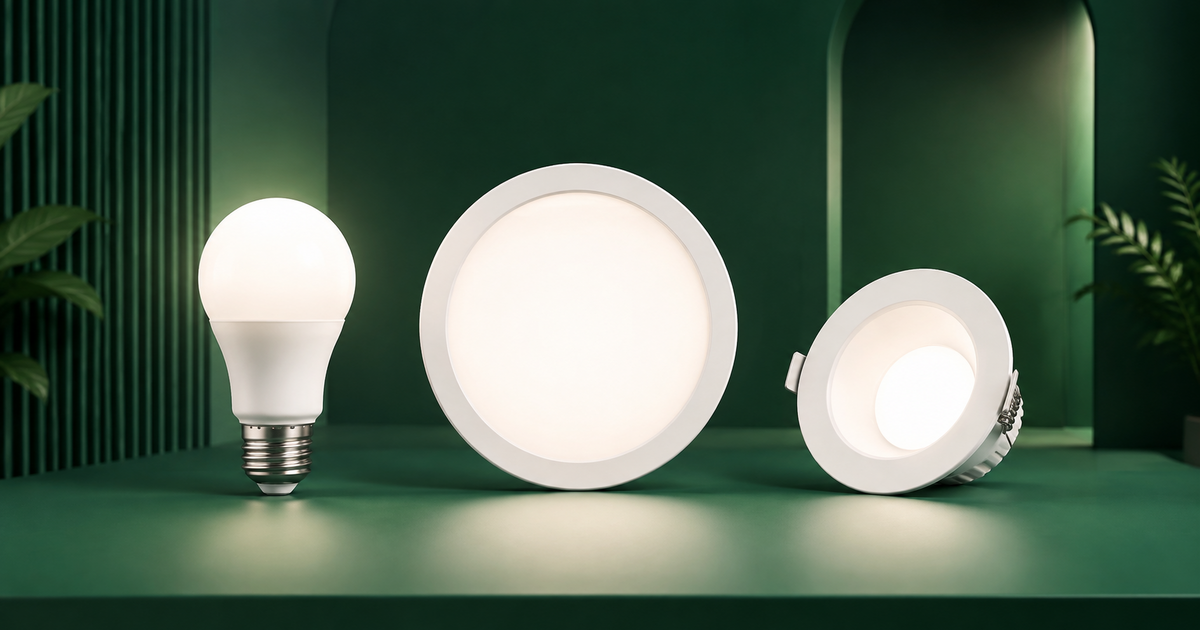
Three LED formats for different needs#
LED bulbs, panel lights and downlights can all provide efficient illumination, but they are not interchangeable. They differ in installation, appearance, light distribution, maintenance and the type of space they suit.
The best choice depends on five questions:
- Do you need a replaceable bulb or an integrated fixture?
- Is the ceiling finished, recessed or surface-mounted?
- Do you want broad general light or more directed illumination?
- How easy should future replacement be?
- What brightness, colour temperature and beam effect does the room need?
Quick comparison#
| Feature | LED bulb | Panel light | Downlight |
|---|---|---|---|
| Typical form | Replaceable lamp | Slim integrated fixture | Compact ceiling fixture |
| Installation | Suitable holder or fixture | Recessed or surface mounting, depending on model | Usually recessed; some surface options exist |
| Light effect | General light, influenced by shade or fixture | Broad, even light | More controlled or directional light |
| Visual style | Familiar and flexible | Clean, modern ceiling appearance | Minimal and architectural |
| Replacement | Often simple if the holder remains suitable | Usually the fixture or driver is serviced/replaced | Fixture or driver may need service/replacement |
| Good for | Existing holders, flexible room lighting | Offices, kitchens, corridors, broad room coverage | Accent, circulation and structured ceiling layouts |
LED bulb: familiar and flexible#
An LED bulb is often the simplest way to upgrade an existing light point. It fits a compatible holder and can usually be replaced without changing the complete fixture.
Advantages#
- Familiar format
- Easy to replace in a compatible holder
- Available in different wattages, shapes and colour temperatures
- Useful for pendant lights, wall fixtures, table lamps and general room lighting
- Allows the decorative fixture and light source to be selected separately
Limitations#
The final result depends heavily on the holder, shade and fixture. A shade may block or redirect light, and a bulb used in an enclosed fitting may retain excess heat if the product is not suitable for that condition.
Choose a bulb when flexibility, easy replacement and compatibility with an existing holder are priorities.
Panel light: broad and even illumination#
Panel lights use a slim fixture format designed to distribute light across a wider luminous surface. Depending on the product, they may be recessed into a prepared ceiling opening or mounted on the surface.
Advantages#
- Clean, modern appearance
- Broad and relatively even light distribution
- Useful for offices, kitchens, corridors and general room lighting
- Can reduce the strong central glare associated with a small, intense source when correctly selected
Limitations#
Installation requires the correct cut-out or mounting arrangement. The complete panel or driver may need replacement when service is required. Ceiling structure and available space must be checked before purchase.
Choose a panel light when broad coverage and a neat ceiling appearance are important.
Downlight: controlled architectural lighting#
Downlights are compact fixtures that direct light downward. Recessed downlights sit within a ceiling opening, producing a minimal appearance; surface-mounted designs are used where recessing is not suitable.
Advantages#
- Clean and unobtrusive ceiling appearance
- Useful for structured lighting layouts
- Can support general, circulation, accent or task lighting depending on beam and output
- Multiple units can create balanced coverage across a room
Limitations#
Poor spacing can create bright spots and dark gaps. Recessed installation needs adequate ceiling depth, suitable cut-outs and attention to thermal conditions. A narrow beam is not ideal where broad coverage is required from only one fitting.
Choose downlights when a controlled, architectural effect and planned fixture spacing are desired.
Which type is suitable for each space?#
Bedroom#
An LED bulb in a suitable fixture offers flexibility, while a small layout of downlights can create a clean ceiling. Avoid excessive brightness and glare near the bed.
Living room#
Use layered lighting. A bulb or panel can provide general light, while downlights can support circulation, displays or selected features.
Kitchen#
Panel lights can provide broad general lighting, while downlights or task lights can support work areas. Plan fixture locations to reduce shadows on counters.
Office or commercial area#
Panel lights are commonly selected for broad, even illumination. The final design should be based on room dimensions, work-plane requirements, glare control and operating hours.
Corridor and staircase#
Downlights or compact surface lights can provide regular coverage. Spacing and emergency-lighting requirements must be considered where applicable.
Do not compare by wattage alone#
The same wattage can produce different brightness and distribution across the three formats. Compare:
- Lumen output
- Beam angle and distribution
- Colour temperature
- Colour rendering information where available
- Dimensions and cut-out size
- Base, holder or mounting type
- Driver and voltage information
- Flicker performance
- IP rating for damp or outdoor areas
- Warranty and serviceability
Read Lumen vs Watt: How to Choose the Right LED Light before comparing brightness, and review 3000K vs 4000K vs 6500K for colour selection.
Compare AKIJ LED lighting formats#
AKIJ Electricals offers published LED bulb, panel light and downlight options for different applications. Use the product pages to compare current wattage, colour, mounting, dimensions and warranty details.
Explore the AKIJ LED Light range
Related products:
- Akij Power Light AC LED Bulb 20W B22 DL
- Akij 7W LED Down Light DL
- Akij LED Panel Light Square Surface 18W DL
- Akij Linear LED Tube Light 10W DL
Common mistakes to avoid#
- Selecting only by product shape
- Comparing wattage without checking lumens
- Buying a recessed light without checking cut-out size and ceiling depth
- Using too few narrow-beam downlights for broad room coverage
- Ignoring glare and fixture spacing
- Using indoor-rated fittings in damp or outdoor areas
- Assuming integrated and replaceable products have the same maintenance method
Conclusion#
Choose an LED bulb for flexibility and easy replacement, a panel light for broad and clean general illumination, and a downlight for controlled architectural lighting. For many rooms, the most comfortable result combines more than one lighting layer.
Reference: ENERGY STAR — Learn About LED Lighting
Frequently asked questions
- Which is best for a living room?
- There is no single best type. A layered combination can provide better general, reading and accent lighting than one fixture format alone.
- Is a panel light brighter than an LED bulb?
- Not automatically. Compare lumen output and light distribution rather than product type or wattage alone.
- Are downlights suitable for general lighting?
- They can be when output, beam angle, spacing and room conditions are properly planned. Too few units may create uneven coverage.
- Which option is easiest to replace?
- A compatible LED bulb is often the simplest because the holder can remain in place. Integrated panels and downlights may require fixture or driver service.